

Close Menu
Poise InStylePoise InStyle
    What's Hot

    Saloni Anand Built Traya Around One Big Idea: Hair Loss Needs More Than a Quick Fix 

    August 12, 2026

    BlissClub Raises ₹160 Crore to Accelerate Offline Expansion and Build an Omnichannel Lifestyle Brand 

    August 10, 2026

    Visa Appoints Adrija Banerjee as Head of AI Practice for North America 

    August 10, 2026
    Instagram Facebook LinkedIn X (Twitter)
    Instagram Facebook LinkedIn X (Twitter)
    Poise InStylePoise InStyle
    Subscribe
    • Women Who Lead
      • Founder Stories
      • Women Leaders
      • Corporate Leaders
      • Creators & Influencers
      • Women in Tech
      • Women In Sports
      • Untold Stories
    • News
    • Brands
      1. Designer Spotlight
      2. Fashion Labels
      3. Beauty Startups
      4. Celebrity Brands
      5. Sustainable Brands
      6. CPG Brands
      7. View All

      How Sarita Handa Built a Luxury Brand by Celebrating Indian Craftsmanship

      June 20, 2026

      Inside Anamika Khanna: The Label That Turned Draped Silhouettes Into Modern Indian Luxury

      April 23, 2026

      Masaba Gupta: The Designer Who Made Indian Wear Feel Like You

      April 23, 2026

      Shyamal & Bhumika: Redefining Indian Heritage for the Modern Woman

      April 6, 2026

      The story of how Neha Kant made Clovia a ₹950 Crore brand by putting a new spin on lingerie shopping in India 

      July 28, 2026

      How Mamta Roy Turned Odette from a Niche Accessories Brand into a Growing Fashion Powerhouse

      June 20, 2026

      Pipa Bella: Redefining Affordable Fashion Jewelry for Modern Indian Women

      April 13, 2026

      Okhai: The Artisan-Led Fashion Brand Redefining Sustainable Women’s Wear in India

      April 13, 2026

      Saloni Anand Built Traya Around One Big Idea: Hair Loss Needs More Than a Quick Fix 

      August 12, 2026

      How Kimberley Ho Built Evereden Into a $100 Million Skincare Brand by Redefining Customer Loyalty 

      July 27, 2026

      From “Unruly” Curls to a Multi-Crore Brand: Anshita Mehrotra and the Making of Fix My Curls

      July 18, 2026

      Forest Essentials: The Ayurvedic Luxury Brand Redefining Indian Skincare 

      April 10, 2026

      How Aashka Goradia Turned a ₹50 Lakh Investment into a ₹1,300 Crore Beauty Brand 

      July 18, 2026

      Neha Marda Turned a Personal Postpartum Challenge into Phitku, a Fast-Growing ₹180 Crore Brand

      July 2, 2026

      Bhumika Pednekar & Backbay: Redefining Premium Water with a Purpose-Driven Brand

      April 12, 2026

      Ed-a-Mamma: How Alia Bhatt is Building India’s Most Conscious Kidswear Brand

      April 12, 2026

      Little Leaf: How Waste Paper Is Turning into Notebooks & Changing Education in India 

      May 6, 2026

      Apratima Biosolutions: The Enzyme Breakthrough Turning Plastic Waste into Fashion’s Future

      May 6, 2026

      How Shivali Sugand’s The GreenGrahi Is Turning Farm Waste into Protein, Profit, and a New Way of Living

      April 24, 2026

      Bare Necessities by Sahar Mansoor Is Redefining Sustainable Personal Care

      March 21, 2026

      From Wall Street to Ice Cream: How Tanvi Chowdhri’s Papacream Is Redefining Affordable Premium Desserts in India

      May 21, 2026

      Eat Better Co.’s Sweet Revolution: How Three Delhi Trailblazers Built a ₹140 Crore Empire Empowering 1,000+ Women

      May 6, 2026

      Namhya Foods: Bringing Ayurveda Back to Everyday Wellness 

      April 10, 2026

      Slurrp Farm: How This Millet-Powered Brand Is Changing Kids’ Nutrition in India 

      April 10, 2026

      Saloni Anand Built Traya Around One Big Idea: Hair Loss Needs More Than a Quick Fix 

      August 12, 2026

      The story of how Neha Kant made Clovia a ₹950 Crore brand by putting a new spin on lingerie shopping in India 

      July 28, 2026

      How Kimberley Ho Built Evereden Into a $100 Million Skincare Brand by Redefining Customer Loyalty 

      July 27, 2026

      How Aashka Goradia Turned a ₹50 Lakh Investment into a ₹1,300 Crore Beauty Brand 

      July 18, 2026
    • PIS Circle
      • Style
        • Power Dressing
        • Everyday Style
        • Capsule Wardrobe
        • Celebrity Style Decode
        • Seasonal Style Guides
      • Smart Living
        • Productivity & Focus
        • Mental Wellbeing
        • Burnout & Balance
        • Confidence & Self Growth
        • Lifestyle Habits
      • Lifestyle
        • Entertainment
        • Art & Culture
        • Travel and Leisure
        • Weekend & DIY
        • Food & Drinks
      • Career
        • Explore Business
        • Leadership Skills
        • Workplace Confidence
        • Negotiation & Salary
        • Personal Branding
    • The Future of Work
      • AI & Technology
      • Startups & Funding
      • Creator Economy
      • Digital Tools
      • Work Trends
    • Podcast
      • The Rangoli Show
    • PIS Media
    • International
    • More
      • About Us
      • Shopping
      • Events
      • Resources
      • PIS Journal
      • Advertise With Us
      • Contact Us
    Poise InStylePoise InStyle
    Home » Ritu Karidhal: The Mission Architect Behind India’s Space Success Story Beyond the “Rocket Woman” Tag
    Untold Stories

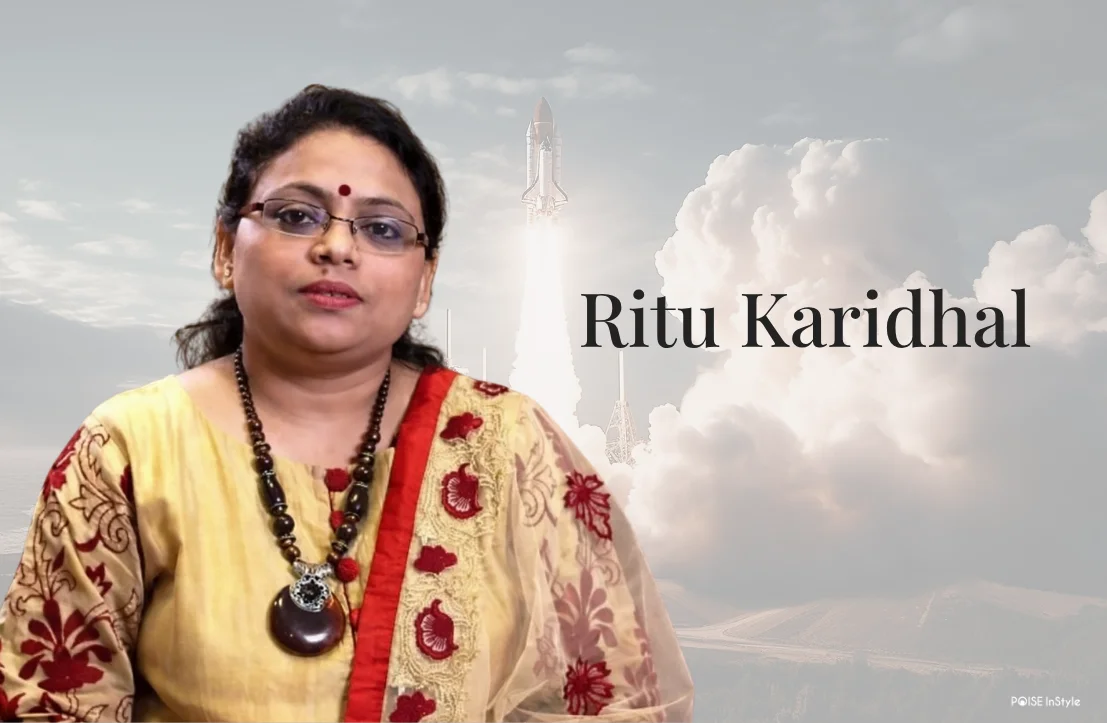
    Ritu Karidhal: The Mission Architect Behind India’s Space Success Story Beyond the “Rocket Woman” Tag

    April 17, 2026Updated:June 18, 202606 Mins Read13 Views
    Facebook Twitter Pinterest LinkedIn Tumblr WhatsApp Reddit Email
    Share
    Facebook Twitter LinkedIn Pinterest Email

    The untold journey of Ritu Karidhal and the engineering mind shaping India’s interplanetary future 

    In India’s space exploration story, some names become instantly recognizable, but only a few are truly understood. Ritu Karidhal is one of them. Widely referred to as the “Rocket Woman,” she is often celebrated for a moment- but her real contribution is far bigger than any single headline. Behind that popular label is a mission architect whose work has quietly powered India’s most advanced space programs for over two decades at the Indian Space Research Organisation (ISRO). 

    Her journey is not defined by spectacle. It is defined by systems, calculations, failures studied closely, and successes built layer by layer. From Mangalyaan to Chandrayaan-3, Karidhal’s role has been less about launching rockets and more about ensuring they think, respond, and survive in the extreme uncertainty of space. 

    From physics classrooms to spacecraft design at IISc 

    Before entering India’s space program, Ritu Karidhal built her foundation in physics and aerospace engineering. She completed her MSc in physics and later an MTech in aerospace engineering from the Indian Institute of Science (IISc), one of India’s most respected scientific institutions. 

    In 1997, she joined ISRO at a time when India’s interplanetary ambitions were still developing. Space missions were becoming more complex, requiring not just engineers who could design systems, but thinkers who could anticipate what might go wrong millions of kilometres away from Earth. 

    Karidhal quickly became part of that core problem-solving culture. Her work was rooted in systems engineering- where every component of a spacecraft must communicate seamlessly, and where even a small error can decide the fate of an entire mission. 

    Mangalyaan: Building intelligence for deep space survival 

    The Mars Orbiter Mission, popularly known as Mangalyaan, launched in 2013, became a defining moment in India’s space journey. It was the first Indian mission to reach Mars and one of the most cost-efficient interplanetary missions ever executed globally. 

    Within this mission, Karidhal played a critical role as Deputy Operations Director. Her key contribution was in developing and managing the spacecraft’s onboard autonomy system- the internal intelligence that allows a spacecraft to function without constant instructions from Earth. 

    This system becomes essential in deep space. Signals between Earth and Mars take minutes to travel, making real-time control impossible. The spacecraft must be capable of making its own decisions, identifying problems, and switching to backup systems when required. 

    Her work ensured that Mangalyaan could operate independently across its long journey, handling unexpected conditions without human intervention. It was not visible work, but it was the kind of engineering that determines whether a mission survives in space or silently fails. 

    When success turns into a label 

    After the success of Mangalyaan, public attention quickly turned toward Karidhal. The media nickname “Rocket Woman” became widely popular, turning her into one of the most recognizable faces of India’s space program. 

    While the label helped bring visibility to women in science, it also simplified a deeply technical career into a single identity. Space engineering is not about rockets alone. It is about mathematics, systems design, software logic, failure prediction, and continuous validation. 

    Karidhal has consistently spoken about this complexity, emphasizing that space missions are built through teamwork and long-term scientific discipline rather than individual heroics. Yet public narratives often prefer symbols over systems, and personalities over processes. 

    As a result, her broader contributions across multiple missions often remain underrepresented. 

    Chandrayaan-2: A mission remembered too narrowly 

    In 2019, Karidhal served as Mission Director for Chandrayaan-2, India’s second lunar exploration mission. The orbiter successfully entered lunar orbit and continues to send valuable scientific data, marking a significant achievement in itself. 

    However, the lander’s unsuccessful attempt at soft landing on the Moon became the dominant public narrative. The final moments of the descent were widely covered, while the broader success of the mission’s orbital phase received far less attention. 

    In engineering terms, Chandrayaan-2 was not a simple failure. It was a partial success that provided critical data, especially in guidance, navigation, and control systems. These learnings later played an important role in refining future missions. 

    But public memory rarely works in layers. It often captures only the most dramatic moment, overlooking the systems that worked as intended. 

    Chandrayaan-3 and the value of engineering memory 

    When Chandrayaan-3 achieved India’s historic soft landing near the Moon’s south pole in 2023, it marked a major milestone for the country’s space ambitions. What remained less visible was the continuity of learning from Chandrayaan-2. 

    Improvements in landing algorithms, redundancy systems, and mission safety design were shaped by earlier experiences. Karidhal’s role in this evolution reflects the core nature of engineering progress- it is cumulative, not isolated. 

    In space exploration, no mission stands alone. Each one carries forward the lessons of the previous attempt. Success is often built on the quiet analysis of what did not go as planned earlier. 

    Beyond headlines: A career built on multiple missions 

    Across her career at ISRO, Ritu Karidhal has contributed to more than 20 missions, including communication satellites, remote sensing projects, and interplanetary explorations. Her expertise spans trajectory design, autonomous spacecraft systems, mission planning, and risk analysis. 

    These are not roles that attract immediate public attention, but they are essential to the success of every space program. They require precision, patience, and the ability to think in systems rather than isolated events. 

    What makes her career significant is not one achievement, but the consistency of her contributions across different types of missions and challenges. 

    The problem with simplified narratives 

    The way Karidhal is often portrayed reflects a broader issue in how scientific careers are represented. Complex technical work is frequently reduced to simplified narratives that are easier to communicate but harder to fully understand. 

    In her case, two moments dominate public perception: the success of Mangalyaan and the landing attempt of Chandrayaan-2. Everything in between- the majority of her professional journey- often disappears from the story. 

    This creates an incomplete picture of what space engineering actually involves. It also risks overlooking the collaborative and long-term nature of scientific work. 

    Karidhal’s career shows that space missions are not built on isolated brilliance, but on sustained engineering discipline shared across teams. 

    Why Ritu Karidhal’s story matters today 

    As India expands its space ambitions and invests in satellite communication, deep-space exploration, and interplanetary missions, the role of engineers like Karidhal becomes even more important. 

    Her work represents a shift in how India approaches space science- from experimental missions to structured, systems-driven exploration. It also highlights the growing presence of women in highly technical leadership roles within institutions like ISRO. 

    For young engineers, especially women entering STEM fields, her journey offers a grounded example of what long-term scientific work looks like. It is not always visible. It is not always celebrated. But it is deeply impactful. 

    The engineer behind India’s space confidence 

    Ritu Karidhal’s contribution to India’s space program cannot be captured by a single nickname or moment. “Rocket Woman” may be what the world remembers first, but it does not reflect the depth of her work. 

    She is a mission architect who helped design the intelligence behind spacecraft, guided interplanetary journeys, and contributed to the evolution of India’s lunar exploration capabilities. 

    Her story is not just about rockets reaching space. It is about the systems that make those journeys possible- and the engineer who quietly helped build them. 

    And in that sense, her legacy is not in the label she was given, but in the missions that continue to succeed long after the headlines fade. 

    Untold Stories Women Leaders Inspiring Change Across Industries
    Share. Facebook Twitter Pinterest LinkedIn Tumblr Email
    PIS Team
    • Website

    beetroot-digital

    Related Posts

    From Kolhapur to Chanel: How Leena Nair Became the First Indian Woman to Lead the $60 Billion Luxury Giant 

    August 6, 2026 Corporate Leaders

    From CA Aspirant to Candle Entrepreneur: How Vritika Agrawal Built House of Aura from a Creative Passion 

    July 30, 2026 Founder Stories

    How Shobana Kamineni Is Redefining Business at Scale Through Innovation, Digital Healthcare, and Purpose

    July 17, 2026 Corporate Leaders
    Add A Comment
    Leave A Reply Cancel Reply

    Demo
    Top Posts

    Aruna Babbar on Building Resilient Leaders in a Fast-Changing World 

    June 8, 2026193 Views

    Brown Mascara Made Me Rethink Everything

    April 30, 2026104 Views

    The Rangoli Show– A Podcast Hosted by Rangoli Jaiswal

    April 27, 2026101 Views

    The Red Lipstick Edit Every Woman Needs

    May 1, 202654 Views
    Don't Miss

    Saloni Anand Built Traya Around One Big Idea: Hair Loss Needs More Than a Quick Fix 

    August 12, 2026 Beauty Startups

    How Saloni Anand turned a personal quest for answers into a science-driven hair health business It…

    BlissClub Raises ₹160 Crore to Accelerate Offline Expansion and Build an Omnichannel Lifestyle Brand 

    August 10, 2026

    Visa Appoints Adrija Banerjee as Head of AI Practice for North America 

    August 10, 2026

    Reliance Retail Acquires AI Startup Furrl to Redefine Fashion Discovery with Personalised Shopping 

    August 8, 2026
    Stay In Touch
    • Facebook
    • Twitter
    • Pinterest
    • Instagram
    • YouTube
    • Vimeo

    Subscribe to Updates

    Stay Ahead in Style, Leadership, and Life - Subscribe Today

    Demo
    About Us
    About Us

    Your destination for modern women’s identity, leadership, and lifestyle stories. POISE InStyle is an identity media platform built to go beyond trends-bringing together ambition, style, career growth, and real conversations that shape how women show up and lead.

    We’re currently open to collaborations, partnerships, and brand features.

    Email Us : connect@poiseinstyle.com
    Phone : +91 7827208040

    Our Picks

    Saloni Anand Built Traya Around One Big Idea: Hair Loss Needs More Than a Quick Fix 

    August 12, 2026

    BlissClub Raises ₹160 Crore to Accelerate Offline Expansion and Build an Omnichannel Lifestyle Brand 

    August 10, 2026

    Visa Appoints Adrija Banerjee as Head of AI Practice for North America 

    August 10, 2026

    Subscribe to Updates

    Stay Ahead in Style, Leadership, and Life - Subscribe Today

    Instagram Facebook LinkedIn X (Twitter)
    • Home
    • Women Who Lead
    • Privacy Policy
    • Terms & Conditions
    • Get Featured
    Copyright © 2026 Poise InStyle. All rights reserved .

    Type above and press Enter to search. Press Esc to cancel.
