


How Saloni Anand turned a personal quest for answers into a science-driven hair health business
It was not with any grand design to form a consumer-health enterprise that Saloni Anand set out to find a remedy for her husband’s hair loss. She was after an answer to what had become a very personal matter.
In the end, that search laid the groundwork for Traya. The brand has since put in place a way of dealing with hair loss that is quite unlike your typical beauty company. Where others might see a case of hair fall as something to be put right with a good shampoo or serum, Traya has built its model on a combination of dermatology, nutrition and Ayurveda to get at the root of the issue.
What was once a private concern has proven to be a substantial business. In recent interviews Anand has spoken of the company’s revenue topping ₹500 crore, with co-founder and wife of Altaf Saiyed now eyeing the next benchmark of ₹1,000 crore as they make inroads into both men’s and women’s markets.
The Personal Problem That Sparked Traya
You could say Traya is the product of the experience of Anand’s husband and fellow co-founder, Saiyed. He had put up with genetic hair loss for some time, but 2017 brought added complications in the form of thyroid issues.
The couple set about looking for solutions, trying their hand at allopathy and lifestyle changes as well as naturopathy and Ayurveda. They came to realise that the beauty industry tends to present hair loss in far too simple a light. In truth, it can be driven by a host of things from hormones and gut health to stress and sleep. And yet the consumer is frequently sold an external quick fix.
That kind of disconnect pointed to an opening in the market which would become Traya’s raison d’être.
Why Traya Chose a Different Approach to Hair Loss
Since its founding in 2019, Traya has made a point of being seen as a health-tech and hair-health firm first and foremost. The methodology is threefold:
– Dermatology to deal with the scalp and follicle
– Ayurveda for internal balance
– Nutrition to pick up on any systemic or dietary influences
There is no one-size-fits-all here. A customer will start with an online assessment so Traya can get a read on their situation before putting forward a plan. That may mean doctor-approved prescriptions, topical treatments or supplements, along with some guidance on diet and lifestyle. And the support does not stop there; doctors and hair coaches are on hand to see the customer through it rather than having them work out a routine in isolation.
Building Trust in a Market Full of Quick Fixes
For a lot of people, losing their hair is a confidence issue, not just a cosmetic one. It is an area where you can expect to see a fair amount of hyperbole and empty promises.
Traya has gone about setting itself apart by making long-term support and clinical review central to the way it does business. The brand is open about the time and consistency needed for recovery, sharing “hope stories” from its customers. Anand says that the regular follow-up and personalised attention from the hair coaches has done much to keep retention high.
It is a proposition that stands in contrast to those brands that rely on a bit of packaging, a celebrity face or a short-lived campaign to make a sale.
At the core of the model is personalisation. With a digital-first stance, Traya is able to gather the kind of data on a customer’s progress and response to treatment that informs everything it does. The reason for this is that the cause of hair loss is not uniform. An individual with a hereditary condition will need to be treated in a very different way to one whose hair fall is the result of stress, a medical issue, hormonal shifts or poor nutrition.
Traya has found a way to meet customers all over India, even where there is no easy access to a specialist clinic, by making use of data and digital consultations to offer personalised advice.
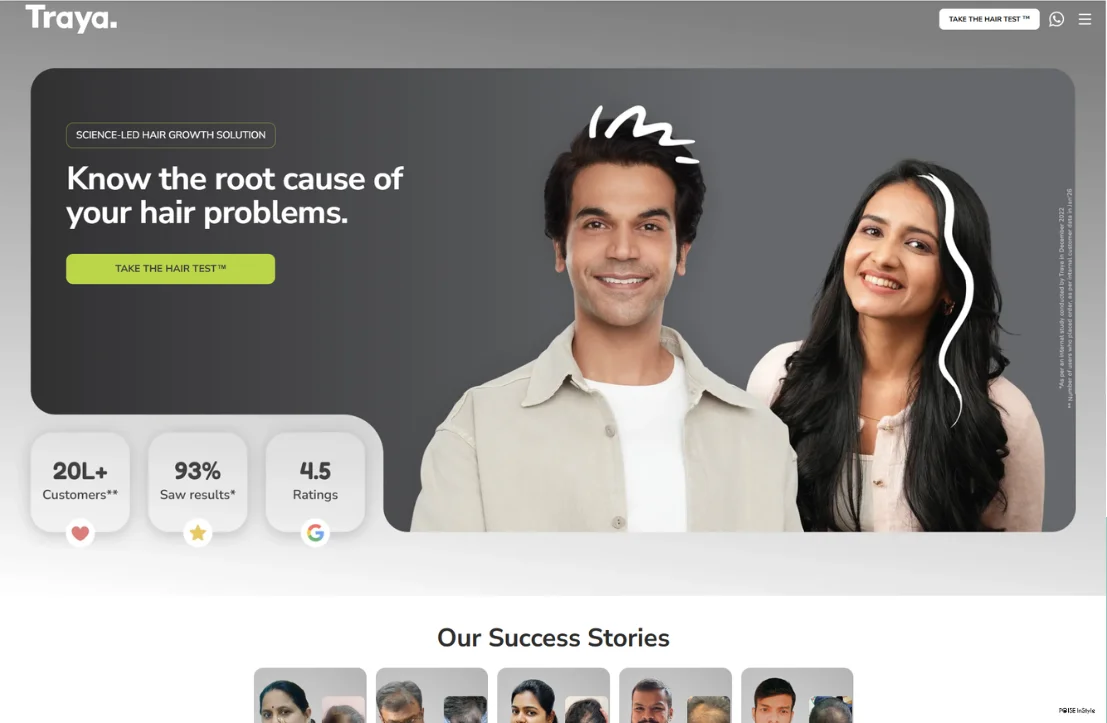
From Men’s Hair Loss to Women’s Hair Health
In its formative years, Traya was driven by men’s hair loss. Anand puts it at 70 per cent of the business. But the company has since broadened its scope with the launch of Traya Women to deal with postpartum hair fall, thyroid problems and other issues specific to women. It is a logical move given that a woman’s hair can be affected by everything from pregnancy and menopause to diet and stress. This opens up the addressable market considerably, and Anand foresees the two segments becoming more of an even match as Traya Women takes off.
The Numbers Behind Traya’s Rapid Growth
Financially, the growth has been marked. Reports indicate revenue has climbed from some ₹65 crore in FY23 to ₹236 crore in FY24. There are varying estimates for the coming year, with some putting FY25 figures between ₹300 and ₹400 crore, while others expect the company to come in at roughly ₹335 crore before hitting the ₹600 crore mark in FY26.
More than a million customers have been served, with one profile showing a repeat rate in the neighbourhood of 80%. The drivers are clear: a well defined problem, the support of doctors and hair coaches, and treatment plans that are tailored to the individual. In many ways, Traya is less of a conventional beauty purchase and more of a recurring health-and-wellness concern.
Can Traya Become a ₹1,000 Crore Brand?
Anand has talked of that as an ambition as the product range and geographical footprint widen, though it is hardly a claim that the figure has been attained. The potential is there in a market like India’s which is still divided between dermatology clinics, supplements, traditional cures and the like. Traya is wagering that consumers will come to prefer a single, guided system. Of course, the test will be to put scale on the model without any let up in clinical oversight or the quality of the service.
What Saloni Anand’s Journey Teaches Entrepreneurs
There is something compelling about the origins of the business. It did not start with some grand market thesis but with a family looking for answers to a hard problem. In doing so they uncovered a wider need for proper guidance and support rather than trial and error.
Anand has taken what was a personal matter – her husband’s hair loss – and made of it a company with over ₹500 crore in revenue. Her view is that hair loss should be seen as a long-term health issue, not a cosmetic bother. If she can deliver on the ₹1,000 crore goal and in the process hold on to the trust and science that have underpinned Traya’s rise, it will make for one of the better consumer-health success stories in India.

