

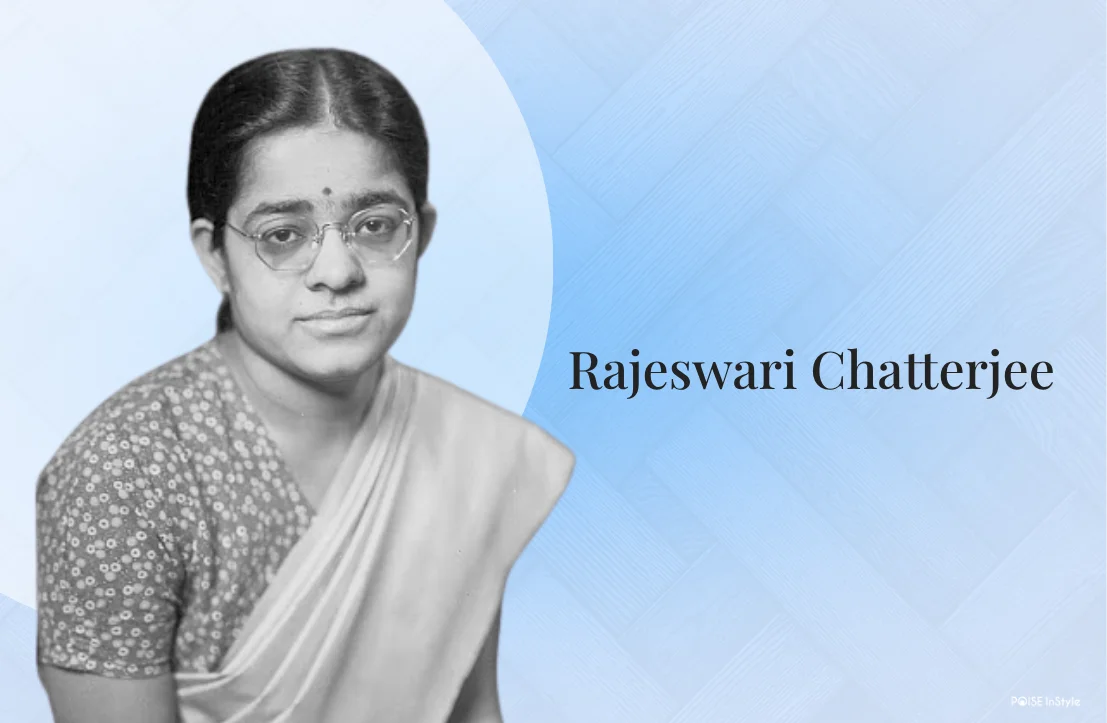
How a lone woman engineer quietly powered the future of radar, satellites, and 5G-era communication
There are stories that dominate headlines, and then there are stories that quietly shape the world without ever asking for attention. The life of Rajeswari Chatterjee belongs firmly to the latter. At a time when India was still finding its footing as an independent nation, and when engineering institutions were overwhelmingly male-dominated, she was not just participating- she was building an entirely new technological foundation for the country.
Today, when we speak about 5G networks, satellite communication, and advanced radar systems, we often focus on modern breakthroughs and global corporations. Rarely do we look back at the early, painstaking work that made these innovations possible. Decades before these technologies became part of everyday life, Chatterjee was already laying their groundwork- experiment by experiment, paper by paper, and student by student.
Entering a system that had no space for her
In the 1940s and 1950s, the idea of a woman pursuing engineering in India was still seen as unusual, if not outright impractical. Social expectations, limited access, and institutional bias combined to keep most women out of technical fields. Against this backdrop, Rajeswari Chatterjee’s journey into engineering was not just ambitious- it was quietly radical.
Born in 1927, she went on to become Karnataka’s first woman engineer, a milestone that signaled both personal determination and the slow shifting of societal boundaries. But her ambitions were not confined to being “the first.” She was driven by a deeper curiosity about how communication systems worked and how India could build its own capabilities in this domain.
Her academic journey took her to the University of Michigan, where she earned her PhD in 1953. At a time when very few Indian women studied abroad- let alone in highly technical fields- this achievement marked her as a pioneer. Yet, instead of building a career overseas, she chose to return to India, bringing her knowledge back to a country that was still developing its scientific infrastructure.
The only woman in the room- and the one building the room
When Chatterjee joined the Indian Institute of Science (IISc), she stepped into an environment that had little precedent for women in engineering faculty roles. For years, she remained the only woman in the Electrical Communication Engineering department. But rather than being defined by isolation, she turned her position into an opportunity to create something entirely new.
In the 1950s, she co-founded India’s first microwave research laboratory along with S. K. Chatterjee. At that time, microwave engineering was still an emerging field globally, primarily driven by wartime innovations in radar technology. In India, however, it was almost non-existent.
There were no established labs, no structured courses, and very limited access to equipment. What existed instead was a gap- and Chatterjee chose to fill it.
Working with minimal resources, she and her team built instruments from scratch, improvised experimental setups, and introduced microwave engineering as a formal area of study. The lab they created was not just a research facility; it was the birthplace of a discipline in India. It became a space where theory met practice, and where students learned not just to understand technology, but to build it.
The invisible foundation of modern communication
Microwave engineering may not be a household term, but its applications are everywhere. From radar systems that guide aircraft and monitor weather, to satellites that enable global communication, to the wireless networks that power smartphones- microwave technology forms the backbone of it all.
Chatterjee’s work focused on key areas such as microwave propagation, antenna design, and passive components. These are not flashy innovations, but they are essential. Without them, modern communication systems simply would not function.
Her research contributed to the development of indigenous capabilities in high-frequency engineering, reducing dependence on imported technologies. Over time, institutions like the Defence Research and Development Organisation (DRDO) built upon these foundations to advance India’s radar and defense systems.
What makes her contribution even more remarkable is how it connects to the present. The same principles she worked on decades ago now underpin millimetre-wave technologies used in 5G networks. While the scale and sophistication have evolved, the core science remains rooted in the kind of early work she helped establish.
In many ways, every high-speed connection today carries a trace of her legacy.
Teaching as a form of nation-building
While her research was groundbreaking, Chatterjee’s impact extended far beyond the laboratory. Over a career spanning nearly three decades, she mentored around 20 PhD students, many of whom went on to hold significant positions in academia, industry, and defense.
Her approach to teaching was deeply practical. She believed that students should not rely solely on theoretical knowledge but should engage directly with the technology- designing, building, and testing their own systems. This hands-on philosophy helped create a generation of engineers who were not just skilled, but self-reliant.
At a time when India was heavily dependent on imported technology, this emphasis on indigenous development was both timely and transformative. Through her students, her influence spread across institutions and sectors, quietly strengthening the country’s technological ecosystem.
The quiet cost of being a pioneer
Despite her achievements, Chatterjee’s story did not receive the recognition it deserved. Unlike many of her male counterparts, her name did not become widely known, nor was her work frequently highlighted in mainstream narratives of Indian science and technology.
Part of this invisibility can be attributed to the nature of her work. Microwave engineering is a highly specialized field, and its contributions are often embedded within larger systems rather than visible as standalone innovations. But gender also played a role. Women’s contributions, especially in technical fields, have historically been underrepresented and undervalued.
For years, she worked without the support structures that are now considered essential for diversity and inclusion. Yet, she continued to focus on what mattered most- her research, her students, and the systems she was building.
Why her story matters today
In today’s world, where conversations around gender diversity in STEM are gaining momentum, Rajeswari Chatterjee’s journey offers both perspective and inspiration. She did not have access to mentorship networks, visibility campaigns, or institutional backing. What she had was resilience, clarity, and an unwavering commitment to her work.
Her story reminds us that progress is not always loud or immediate. Sometimes, it is built slowly, through years of consistent effort and quiet determination. It also highlights the importance of recognizing foundational contributions- the kind that make future innovations possible but often go unnoticed.
As India continues to expand its capabilities in 5G, satellite communication, and defense technology, revisiting her work is not just about giving credit where it is due. It is about understanding the roots of that progress.
Remembering the architect behind the signals
Rajeswari Chatterjee did not seek the spotlight, and perhaps that is why history allowed her story to fade into the background. But her impact is impossible to ignore. She built India’s first microwave research lab, shaped an entire field of study, and trained a generation of engineers who carried her work forward.
In a world that often celebrates outcomes more than origins, her life is a powerful reminder that every breakthrough stands on a foundation laid by someone else.
She may not be widely remembered, but her work is everywhere-moving through the airwaves, connecting people, powering systems, and shaping the future.
And maybe it’s time we started telling her story the way it deserves to be told.

