

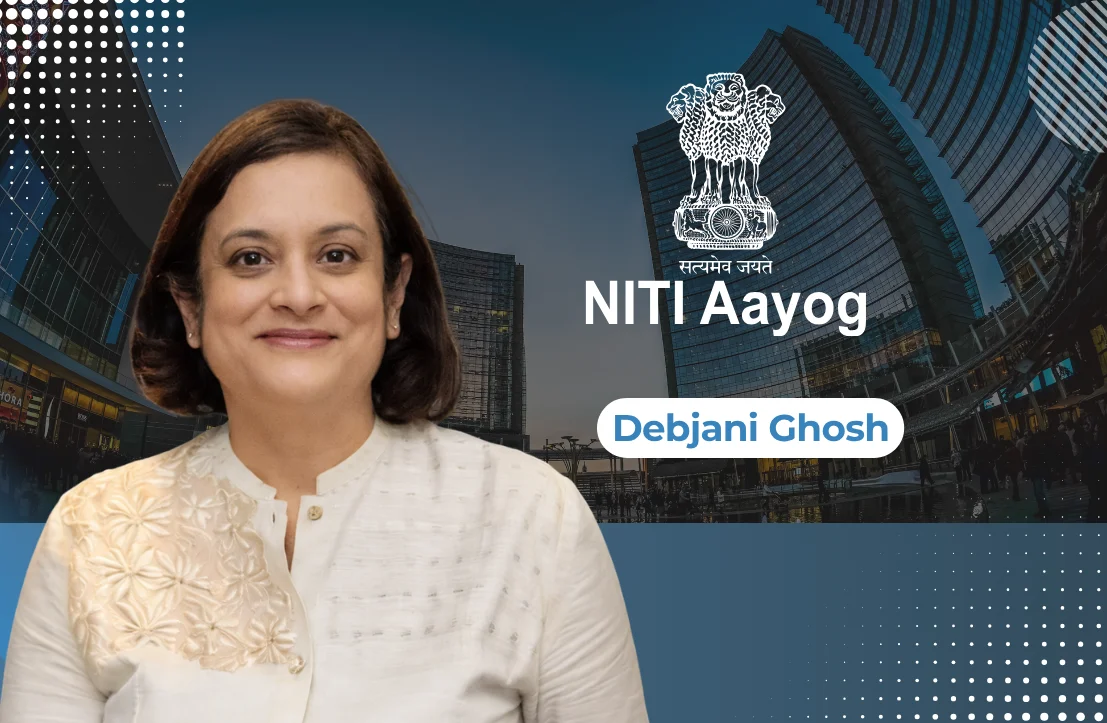
There are leaders who grow within systems, and then there are those who quietly reshape them.
Debjani Ghosh belongs to the second kind.
Her journey doesn’t follow a predictable arc. It moves across ideas, industries, and influence-connecting technology, business, and policy in a way that feels both intentional and instinctive. What makes her story compelling is not just the positions she has held, but the questions she has asked along the way.
Questions like-what role should India play in the global tech landscape?
And more importantly-how can technology create real, inclusive progress?
A Beginning That Didn’t Fit a Template
Debjani didn’t begin her journey with a conventional tech identity. She wasn’t boxed into a single discipline, and that turned out to be her biggest advantage.
Her early academic interests allowed her to understand systems-not just in terms of technology, but in terms of people, behavior, and decision-making. This broader lens helped her see patterns where others saw silos.
And that perspective stayed with her.
Even later, when she stepped into the world of technology, she didn’t approach it as a technical problem to solve. She approached it as a human opportunity to expand.
Learning Inside the System Before Leading It
Her years in global technology companies-especially Intel-were not just about career growth. They were about observation.
She saw how technology scaled.
She saw how markets responded.
She saw where gaps existed.
But what stood out most was her ability to connect those dots.
While many focused on expansion, she paid attention to inclusion—how technology could move beyond metros and into spaces where it could actually change lives.
That thinking wasn’t loud or disruptive.
It was quiet, consistent, and deeply strategic.
The Moment That Shifted Everything
When she stepped into NASSCOM as its first woman president, it wasn’t just a leadership milestone-it was a transition point for the entire industry.
India was already known for its IT services strength. But there was a deeper ambition waiting to be realized.
Debjani didn’t come in with a rigid plan.
She came in with clarity.
The kind of clarity that doesn’t rush change, but **guides it steadily.**
Reimagining India’s Role in Technology
One of the most defining aspects of her leadership was how she reframed India’s position globally.
She didn’t reject the country’s strengths in services.
She expanded the narrative.
Suddenly, conversations began to shift-from efficiency to innovation, from support to ownership.
Her articulation of the “Techade” wasn’t just a vision for the future. It was a way of telling the industry:
We don’t have to follow. We can lead.
And slowly, that idea began to take root.
Working at the Intersection of Industry and Policy
What makes Debjani’s journey particularly interesting is how it moves beyond corporate leadership into policy influence.
Her transition into a national-level role reflects a natural progression-not a departure.
Because when you’ve spent years understanding how industries evolve, the next step is to influence how ecosystems are built.
Her work now sits at that intersection—where technology meets governance, and innovation meets responsibility.
It’s not just about what India builds.
It’s about how India builds it-and for whom.
A Leadership Style That Feels Real
There’s something refreshingly grounded about the way she leads.
It’s not about commanding attention.
It’s about creating alignment.
She listens.
She questions.
She connects.
And in a world where leadership is often associated with certainty, she leans into curiosity.
Because she understands something fundamental:
Technology doesn’t stand still.
And neither can leadership.
Quietly Changing the Narrative for Women in Tech
Debjani’s presence in leadership isn’t performative-it’s impactful.
She hasn’t just opened doors.
She has changed how those doors are perceived.
By focusing on capability over labels, and impact over identity, she has contributed to a more inclusive narrative-one where women in tech are not exceptions, but essential voices.
And that shift matters.
Because representation is not just about visibility.
It’s about possibility.
Building Systems That Outlast Roles
If there’s one thread that runs through her journey, it’s this-she builds for the long term.
Not just organizations, but ecosystems.
Not just outcomes, but frameworks.
Whether it’s skill development, startup enablement, or industry collaboration, her work consistently reflects a belief in creating structures that can sustain growth beyond individuals.
That’s what makes her impact enduring.
What Her Journey Teaches Us
There’s no single formula to draw from her story. But there are patterns worth noticing.
The importance of staying open to learning.
The value of thinking beyond immediate roles.
The ability to connect ideas across domains.
And perhaps most importantly-the courage to think ahead, even when the path isn’t fully defined.
Closing Thought
Debjani Ghosh’s journey doesn’t feel like a series of milestones. It feels like a continuous evolution.
One where each phase builds on the previous, and each decision expands the scope of impact.
In the world of POISE InStyle, she represents *Women Who Lead* in its truest sense:
Not just by rising, but by reshaping what leadership looks like.
And maybe that’s the most powerful takeaway-
Sometimes, leadership isn’t about being the loudest voice in the room.
It’s about asking the questions that change the room entirely.

